Showing posts with label player profile. Show all posts

Friday, February 10, 2012

Player Profile: Bobby Charlton


Bobby Charlton
11th October 1937
Country: England
Major Clubs: Manchester United

"I wonder all over again how so much could come to one man simply because he was able to do something, which for him was so natural and easy, and which he knew from the start he loved to do more than anything else", said Bobby Charlton in his autobiography, My Manchester United Years. He was a player whose life was changed in the blink of an eye. One of the original Busby's Babes, Charlton was a Red Devil throughout the extent of his career. He played 759 games for Manchester United, and scored 249 goals in the duration of 17 years at the club.

One thing in Charlton's life that haunts him till date is the Munich air disaster. Seven of his teammates, including the great Duncan Edwards, died in the disaster, but Charlton somehow managed to pull himself out of the injuries he sustained. Later, he along with Matt Busby's assistant Jimmy Murphy, was responsible for the resurrection of the club. He possessed qualities of being a terrific goal-scorer, as well as being able to score splendid goals; something of a rarity in English football at the time.

In 1966, England hosted the FIFA World Cup. The team that year was completely in the hands of Alf Ramsey, who selected Charlton for the side playing the World Cup Finals. His contribution to England was commendable throughout the tournament, as he won himself the Golden Ball that year. However on 30th July 1966 when England played their World Cup Final at Wembley, Charlton was rather quiet. England, though, went on to win the cup.

Two years later, he captained United to remarkable run in the European Cup, leading a team that became the first English side to reach the cup final. The final, played at Wembley against Benfica, was a tight affair, until Charlton scored twice in extra time to hand United a 4-1 victory.

Much later, during his days at Old Trafford, he was a part of the Holy Trinity which included himself alongside Denis Law and George Best. George Best said for Charlton, "I've never seen anyone go past players as easily as he did.". On the individual front, the list of the honours he's won is too long to be written here. But some of the greatest honours such as the Ballon d'Or, FWA Footballer of the Year, among others still dress up his cabinet.

Bobby Charlton went on to manage Preston North End towards the end of his career, and also had a brief spell at Wigan as a caretaker manager. However, he didn't embark on a full fledged career in management. Charlton was conferred with the knighthood in 1994, and is currently on the Board of Directors at Manchester United.

His contribution to the club is and probably will be unmatchable by anyone so far, and even in the future. Despite the many blows he took at Manchester United, starting from the Munich disaster, to the 1958 FA Cup loss, and the 1969 European Cup defeat, Charlton believed in hanging in there, unlike many of the modern footballers who change colours for medals.

-PRANAV MUKUL

Written for India's premier football magazine: 90 minutes (October 2011)

Tuesday, November 29, 2011

Player Profile: Anwar Ali


Anwar Ali
24th September 1984
Country: India
Major Clubs: JCT, Dempo, Mohun Bagan


At 189 cm, Anwar Ali is one of the tallest players in the Indian national football team. From JCT to Dempo, and now to Mohun Bagan, Anwar has steadily moved up the Indian football ladder, and is also a regular for the national team.

Anwar started playing at the Rurka Kalan Academy in Phagwara, which also happens to be his home town. After graduating from the academy, the 26-year old played for some local teams, before featuring for Punjab in the Santosh Trophy in 2004, where his side reached the finals.

Later that year, he went on to join Punjab Police. And it was during his time there that he started playing as a center back as opposed to his previous position of right back. He grew into the role steadily, and it wasn’t long before JCT were aware of his performances, and signed him up. Since then, he’s managed to make his mark on Indian football, and has forged a good career for himself.

The Durand Cup in 2006 was a big tournament for Anwar, and it would be turn out to be the moment when he burst onto the national scene, thanks to some sterling performances. JCT went all the way to the final, and the Phagwara boy put in another great shift in defence, but couldn’t save his side from losing to Dempo.

After his performances at the Durand Cup, he was awarded the tournament’s ‘Most Promising Player’ award. He then went on to complete a fantastic season, as he helped JCT finish second in the then National Football League (NFL).

Along with his qualities as a footballer, his physical strength was vital in convincing Bob Houghton he was ‘India material’, and he was called up to the national team for the 2008 SAFF Cup. However, he came into the limelight for the first time as an India player during the AFC Challenge Cup later in the year, where India conceded only thrice in six games. In the tournament, he forged a fine partnership with Gouramangi Singh in central defence, and has since established himself as a regular in the national squad.

The very next season, Anwar left JCT and moved to Goa to join champions Dempo SC. However, he stayed there for only one season, playing 18 matches for the Goan side, after which he shifted base to Kolkata in 2010, as a Mohun Bagan player. His first season with the Bagan wasn’t as successful as he might have hoped, since the Maidan club only managed to finish 6th in the league. Nonetheless, Anwar feels that things will improve. He recently said, “It was my first year in Kolkata and I’ve gained some good experience which I shall put to use this season. I hope this year’s experience would be even better.”

Interestingly, he’s also the second Indian to have trained with English Championship side Coventry City (Sunil Chhetri had earlier gone there for a trial), as he went there for a training stint last month. His pace, being one of his weaknesses, was apparent to himself when he trained with other footballers in England, and should help him understand his game better and learn to work around it. The knowhow which he gained from Coventry should prove to be extremely beneficial for him, Bagan, and India, and could help the lad who is just coming into his prime as a footballer.


-PRANAV MUKUL

Written for India's premier football magazine: 90 minutes (September 2011)

Monday, October 31, 2011

Player Profile: Alfredo Di Stefano


Alfredo Di Stefano

4th July 1926.

Country: Argentina

Major Clubs: River Plate, Millonarios, Real Madrid, Espanyol


Though you can read his nationality as Argentine, Di Stefano played for three different countries during his gilttering career as a footballer - Argentina, Columbia and Spain. However, he did not play at the World Cup finals even once.

He started his professional career at the age of 17 by playing for River Plate in Buenos Aires where he was born, and from there the journey of this legend started as he only made more than just a mark on Millonarios, Real Madrid and finally Espanyol. His journey from the Americas to Spain has been followed so much in Spain, that a Spanish movie titled as his nickname, "Saeta Rubia", has been produced to portray his life in Spain.

The list of his honours is never ending but what one always remembers him for is his pivotal role in Real Madrid's European success in 1950's. Also, it was the Spanish giants who asked Di Stefano to convert his citizenship to Spanish, so they could utilize their foreign spot for the newly signed Raymond Kopa. The 11 years he spent at Madrid were probably the golden years of his career, as he led a powerful line up from the front, with other star players such as Raymond Kopa, Ferenc Puskas, Francisco Gento, et al.

Di Stefano is essentially considered to be the best 'all-rounder' of all time. Yes, we're still talking about football, nothing else. The remarkable stamina and agility he possessed helped him to be an all-rounder of sorts, on the field. He could roam anywhere over the length of the pitch owing to these qualities, which allowed him to even defend, distribute the ball, give orders to other players and of course, score goals. His presence on the field was so crucial, that his former coach at Madrid, Miguel Munoz said, "The greatness of Di Stefano was that, with him in your side, you had two players in every position."

Apart from the other qualities Saeta Rubia flaunted, his main quality was very straightforward - to take the ball and out it in the back of the net. He scored 307 goals in 397 appearances at Madrid, and won the Pichichi award for scoring the highest goals in a La Liga season five times during his career there. Post Madrid, Di Stefano moved to Espanyol in 1964. He did decently at the Catalan outfit, and two seasons later, he retired from football as a player.

However, he was still connected to the game. He later went on to manage clubs such as Elche, Boca Juniors, Valencia, Real Madrid, Sporting Lisbon, Rayo Vallecano, Castellon and River Plate. In 1990, while he was still managing Real Madrid, he was appointed as the advisor to the president of Los Merengues.

Only a year later he was appointed as the president of the former players of Real Madrid. His contribution to the club's administration didn't end there either, as in 2000, he was appointed as the honorary president of the Spanish giants. In 2006, to respect his contribution to the Los Blancos, the "Alfredo Di Stefano stadium" was inaugrated, and is the stadium which the first team uses to train.

Written for India's premier football magazine: 90 minutes (July 2011)

-PRANAV MUKUL

Tuesday, May 3, 2011

Player Profile: Bobby Moore


Bobby Moore

12th April 1941.

Country: England

Club played for majorly: West Ham United

He stands 20ft. tall at the Wembley weighing about two tons, portraying the many successes he has won for his country. “He was my friend as well as the greatest defender I ever played against,” said Pele himself for this English Captain who was the first and till date remains the only one to have won the World Cup for England.

Robert Fredrick Chelsea Moore a.k.a. Bobby Moore is considered to be one of the greatest footballers in the history of England as well as West Ham United. He held a record of 108 caps for England until March 28th 2009, when David Beckham played against Slovakia at the Wembley. But unlike Beckham, Bobby Moore has played every single minute of every single cap he’s earned. He was a poised central defender and was well known for his ability to foresee the opposition’s movements. To mock his ability former Celtic centre half Jock Stein once said, “There should be a law against him. He knows what's happening 20 minutes before everyone else.”

Moore joined West Ham United in 1956 as a youth player and advanced through this setup to join the senior team on September 8th, 1958 playing his first match against Manchester United. But he’s more a legend for the English team than for The Hammers. It is said that in early 1966 Bobby Moore wanted to leave West Ham the reason being some heat he shared with his club manager Ron Greenwood. Also, the fact that his demand of £10 more per week as his wage with his contract expiring at the end of that month wasn’t being fulfilled made him decide that he would leave the club as soon as his contract expired. But Sir Alf Ramsey who was then the manager of England, intervened timely and helped Moore realize that he would become technically ineligible to contribute for the England squad if he left the club. Ramsey called Greenwood to the hotel where the English team was staying and told him and Moore that they had one minute to sort out their problems. Moore then signed a one month contract to elongate his stay at Upton Park which allowed him to captain the English National Team for the World Cup they later went on to win.

After the World Cup win, he won several individual honours including the “BBC Sports Personality of the year” and the OBE (Order of the British Empire) at the end of 1966.

He ultimately left West Ham in 1974 after playing for 16 years and making 544 appearances while scoring 24 goals in the process. After leaving West Ham he joined Fulham where he played for three years. Ultimately, he retired from club football playing for the Danish club Herning Fremad which is now known as “FC Midtjylland”.

Other than football, he also played county cricket for Essex with his West Ham teammate Geoff Hurst. More than being just a good footballer, Moore was also a good person and a good teammate. When the English team got a £22,000 bonus for winning the World Cup, Moore insisted that the money should be split between every player in the 22-man squad regardless of whether he played or not.

Also published here


-PRANAV MUKUL


Tuesday, April 26, 2011

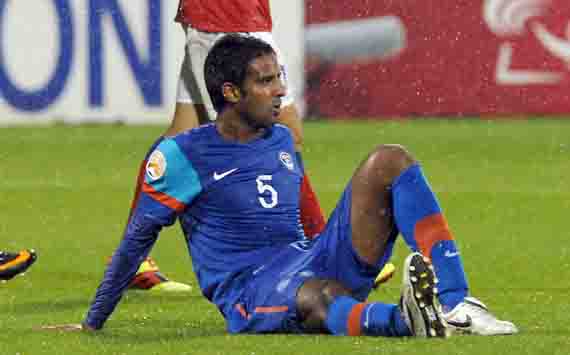
Player Profile: NP Pradeep


NP Pradeep
April 28th 1983.
Country: India
Club: Viva Kerala


Naduparambil Pappachen Pradeep. His contribution to the game is as weighty as his name. NP Pradeep better known as Pradeep, is an attacking midfielder who plays for the i-League outfit Viva Kerala. Originally from Kerala, Pradeep started his senior career with the team of State Bank of Travancore (SBT) in 2002 at the age of 17. Before that, Pradeep started off as a striker playing for the state of Kerala at the U-17 and later the U-19 levels. He then turned himself into a midfielder soon after joining SBT. He represented SBT till 2006 during which he played 56 games and scored 8 goals. During his stay at SBT, he managed to win four Kerala league titles for his club.

After leaving SBT in 2006, Pradeep joined Mahindra United. Incidentally, his record of 56 appearances and 8 goals was repeated at his new club till 2010 when the club was disbanded. He experimented with various positions while at Mahindra and sometimes even played as a full-back. At Mahindra United he was benched for a lot of the season 2008-09 and at the end when the coach Derrick Pereira left the club, Pradeep was visibly happy to see him go. Pradeep, on his birthday in 2009 said, “Last season, I was benched for most parts of the season and that didn’t please me one bit. For me, Derrick leaving Mahindra is good.” Despite all this he managed to win two IFA shields with Mahindra in 2006 and 2008. He also contributed to his club reaching the quarter finals of the AFC Cup.

It was his contribution to Mahindra in the AFC Cup that caught Bob Houghton’s attention. This led to him being called up for the National Squad. Initially he started playing as a left-back for India but progressively he came back to his position of a goal-scoring mid fielder. For the national team, Pradeep actually came into the lime-light post the Nehru Cup 2007. He scored the most important goals of the tournament. He scored the opening goal of the Nehru Cup for India and he also scored in the final against Syria making it the only goal of the game and helping India lift the Nehru Cup for the first time. After the cup, Pradeep became a regular in the starting XI for the English coach and has been proving his worth since then.

Later as Mahindra played him at various positions, Pradeep started losing form. Eventually when the club broke up, he remained a free agent for some time until joining Viva Kerala in January 2011 late in the transfer window. Even in Qatar during the AFC Asian Cup, Pradeep’s role in the team was crucial since India hasn’t produced many attacking midfielders of his kind. To his credit, he has also been tipped by various critics to surpass the former Indian captain I.M. Vijayan considering his talent and skills on the pitch.


Also published here